

Introduction: The Stability Crisis in Global Air Care Logistics
In the rapidly growing market for solid car air fresheners (gel perfumes), manufacturers face a persistent engineering challenge: Temperature Instability.
Global supply chains expose products to extreme environments. A shipping container stuck in a port during a Russian winter can drop to -20°C, while a finished product sitting on a dashboard in a Dubai summer can easily exceed +70°C.
- The Problem: Traditional stabilizers like Carrageenan, Gelatin, or Agar are essentially “melting gels.” Under thermal stress, they often liquefy, leak oil (syneresis), or suffer from structural fracture upon freezing.
- The Consequence: This leads to high return rates, damaged packaging, and a loss of consumer trust.
This guide explores the chemical solution to these issues: Low Acyl Gellan Gum, a structural hydrocolloid that is replacing traditional thickeners in high-performance air care formulations.
1. What Is Gellan Gum and Why Switch?
Gellan Gum is a microbial polysaccharide produced through fermentation (Sphingomonas elodea). Unlike plant-derived gums that can vary by harvest, fermentation allows for precise molecular consistency. For detailed specifications (CAS 71010-52-1), please visit our main Gellan Gum Product Page.
The Science: Thermal Irreversibility
The key differentiator for air freshener applications is the gelation mechanism. Unlike Carrageenan, which forms thermoreversible gels (melts when heated and resets when cooled), Low Acyl (LA) Gellan Gum forms a non-thermoreversible gel in the presence of cations (like Calcium or Magnesium).
- Structural Integrity: Once the 3D network is formed and set, it stays set. The gel structure typically withstands temperatures well above 100°C without losing its shape.
Formulator’s Note: Think of Gellan Gum not just as a thickener, but as a “structural scaffold” that locks your fragrance and water phase into a heat-stable matrix.
2. Critical Performance Metrics (Lab Stress Testing)
To validate performance, comparative stress tests were conducted in controlled laboratory environments, simulating accelerated aging and extreme transport conditions.
A. Extreme Heat Resistance (The 80°C Dashboard Simulation)
Test Scenario: Samples were subjected to a constant temperature of 80°C for 24 hours to simulate peak summer dashboard conditions.
- Standard Hydrocolloids: exhibited softening, deformation, and significant phase separation (oil leakage).
- Low Acyl Gellan Gum: maintained zero deformation. The gel structure remained rigid with no oil leakage or water syneresis, verifying its suitability for automotive use.
B. Cold Tolerance (Freeze-Thaw Cycle)
Test Scenario: Samples were stored at -16°C for 24 hours then thawed to room temperature.
- Standard Hydrocolloids: Ice crystal formation often fractured the gel matrix. Upon thawing, this resulted in “weeping” (water release) and visible cracks.
- Low Acyl Gellan Gum: Maintained an intact structure. While micro-crystals form, the robust cross-linking of the Gellan network prevents structural collapse, retaining elasticity and visual integrity after thawing.
C. Fragrance Loading Capacity
Observation: High oil content can destabilize water-based gels.
- Result: Properly formulated Gellan Gum matrices supported ≥5% fragrance/essential oil loading without emulsification breakdown. The unique molecular mesh allows for a steady, controlled release of volatile organic compounds (VOCs) over typical 30-60 day product lifecycles. To enhance fragrance longevity, some formulators also incorporate Ethyl Vanillin as a fixative.
3. Product Selection: Choosing the Right Grade
While the base chemistry is consistent, HylixChem typically offers specific grades tailored to end-product requirements.
Type A: High Gel Strength (Commercial Grade)
- Focus: Durability and Cost.
- Characteristics: Creates a very firm, brittle gel (≥900g/cm²).
- Best Application: Functional under-seat gel blocks where aesthetics are secondary to longevity.
Type B: High Transparency (Premium Grade)
- Focus: Aesthetics.
- Characteristics: High clarity (82% – 88% Light Transmittance) with high yield value.
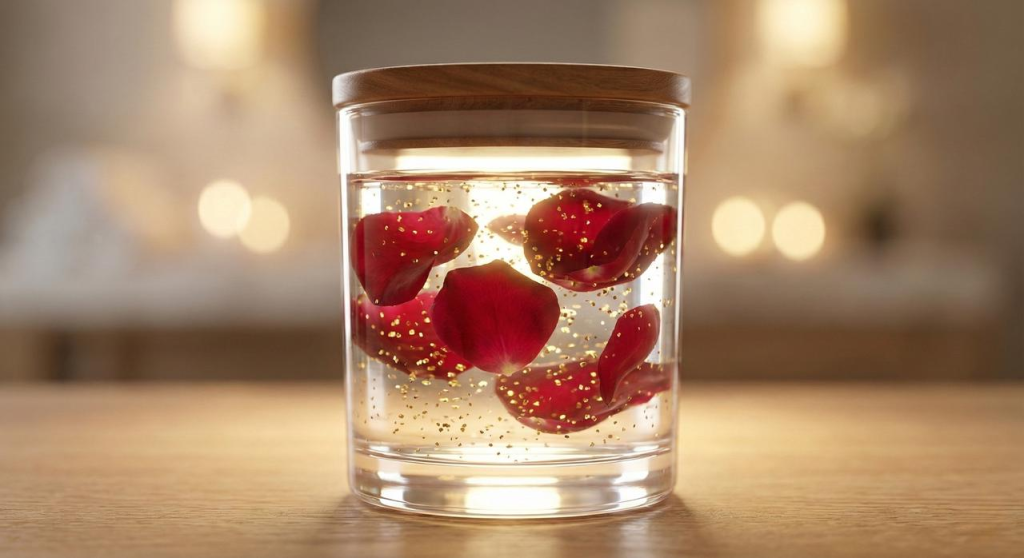
- Best Application: “Instagrammable” clear jar perfumes capable of suspending decorative elements (flower petals, glitter, beads) permanently without sinking.
4. Technical Comparison: Gellan Gum vs. Alternatives
Is Gellan Gum always the perfect choice? Not necessarily. It depends on your texture goals.
| Feature | Low Acyl Gellan Gum | Carrageenan | Agar-Agar | Gelatin |
|---|---|---|---|---|
| Melting Point | >120°C (Heat Stable) | ~60-70°C | ~85°C | ~35°C |
| Heat Stability | Excellent (Dashboard Safe) | Poor (Melts in Summer) | Good | Very Poor |
| Clarity | Crystal Clear | Cloudy/Translucent | Cloudy | Clear (but melts) |
| Dosage Efficiency | High (0.5% – 0.8%) | Medium (1.5% – 2.5%) | Medium (1.0% – 2.0%) | Low (3.0% – 5.0%) |
| Freeze/Thaw | Stable | Syneresis (Weeps) | Syneresis | Poor |
| Texture Profile | Firm & Brittle | Elastic / Rubber-like | Brittle | Gummy |
Texture Tip: Gellan Gum is naturally brittle. If your product requires a “bouncy” or elastic texture, we recommend blending it with Xanthan Gum or Konjac Gum to modify the rheology.
5. Decision Guide: Is Gellan Gum Right for Your Product?
Before reformulating, consider these decision factors:
YES, Switch to Gellan Gum if:
- You export to regions with extreme climates (Hot summers/Cold winters).
- Your product sits in direct sunlight (Car dashboards/Windowsills).
- You need a crystal-clear “premium” look with suspended petals/beads.
- You want to reduce warehouse space (lower dosage = less raw material storage).
CONSIDER ALTERNATIVES if:
- Price is the only factor: Standard Carrageenan can be cheaper per kg (though Gellan’s lower dosage often balances the cost-in-use).
- Texture preference: If you specifically need a “gummy bear” like texture, Gellan might be too firm unless blended with plasticizers.
6. Formulation Guide: Basic Heat-Resistant Gel
(Note: This is a starting framework. Adjustments may be needed based on your specific fragrance oils.)
Ingredients:
- Water (Deionized): 90%
- HylixChem Air Freshener Grade Gellan Gum: 0.5% – 0.8%
- Chelating Agent (Sodium Citrate): 0.1% – 0.2% (Helps hydration)
- Emulsifier/Solubilizer: As needed for fragrance.
- Fragrance Oil: 3% – 5%
- Preservative: 0.1% (e.g., Sodium Benzoate or Potassium Sorbate to prevent mold).
- Cation Source (Calcium Lactate): 0.05% – 0.1% (Crucial for setting)
Process:
- Dispersion: Mix Gellan Gum with Sodium Citrate and disperse into cool water under agitation.
- Heating: Heat to 85°C – 90°C until fully hydrated and clear.
- Fragrance: Cool slightly (approx 75°C), then add pre-mixed fragrance/emulsifier and preservative.
- Gelation: Add the Cation Source (Calcium) dissolved in a small amount of water.
- Pouring: Immediately fill molds. The gel sets rapidly as it cools.
Frequently Asked Questions (FAQ)
Q: Why is my gel cloudy? A: Cloudiness usually stems from three issues: incomplete hydration (didn’t heat to 85°C+), poor fragrance emulsification, or using the wrong calcium source. For high-clarity needs, ensure you are using a “High Transparency” grade.
Q: Can I simply replace Carrageenan with Gellan 1:1? A: No. Gellan is much more powerful. You typically need only 1/3 to 1/2 the amount of Gellan Gum compared to Carrageenan. You will also need to ensure a proper cation (calcium) source is present to trigger the gel.
Q: Do you support custom formulations? A: Yes. At HylixChem, our lab supports formulation adjustments. We provide 200g-500g samples for R&D testing to help you find the right balance between cost and clarity.
Ready to weather-proof your air fresheners?