

Document Type: Technical Guide | Target Audience: Food Scientists & R&D Managers Version: 2.0 (Comprehensive Edition)
1. Executive Summary: The Hydrocolloid of the Future
In the modern landscape of food hydrocolloids, Gellan Gum (E418) has emerged as the “gold standard” for stability and texture. Originally discovered in 1978 in a lily pond in Pennsylvania, this fermentation-derived polysaccharide has evolved from a niche ingredient to a critical stabilizer in the global food and beverage industry.
However, the binary distinction between High Acyl (HA) and Low Acyl (LA) forms remains a source of confusion. Selecting the wrong type doesn’t just affect texture; it impacts processing temperatures, ion requirements, and shelf-life stability.
This white paper provides an exhaustive technical analysis of both variants, offering formulation engineers a roadmap to mastering texture engineering.
2. Molecular Architecture: The “Acyl” Mechanism
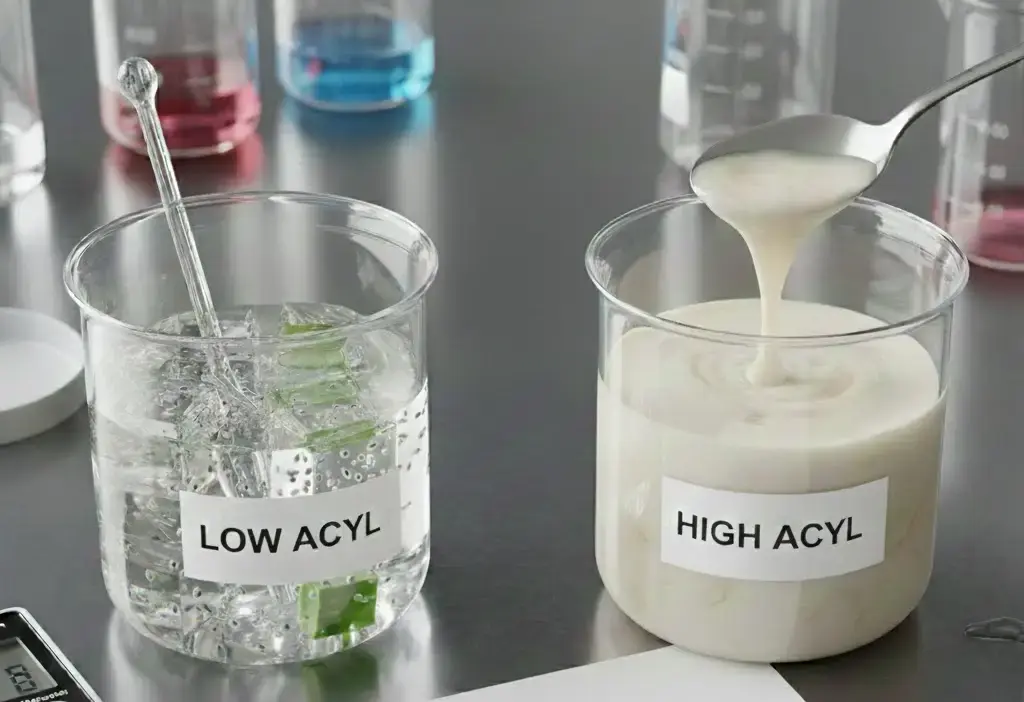
To control texture, one must understand the molecule. Gellan Gum is an anionic polysaccharide produced by the bacterium Sphingomonas elodea.
The Native Structure (High Acyl)
The “native” form secreted by the bacteria is High Acyl.
- Molecular Backbone: A repeating tetrasaccharide unit (Glucose – Glucuronic Acid – Glucose – Rhamnose).
- The “Spacers”: It contains two acyl substituents per repeat unit:
- Acetyl group (C2 position)
- Glyceryl group (C6 position)
- Function: These bulky acyl groups act as physical spacers. They prevent the double helices from packing tightly together during gelation.
- Resulting Texture: The loose network creates a soft, elastic, and flexible gel that yields easily under pressure but recovers quickly.
The Modified Structure (Low Acyl)
Through a controlled alkali treatment (de-acylation), the acyl groups are stripped away.
- Structural Change: Without the bulky spacers, the linear chains can align and pack extremely closely.
- Function: In the presence of cations (Ca++, Mg++, K+, Na+), these tight bundles form “junction zones” that are chemically strong and rigid.
- Resulting Texture: A hard, brittle, and non-elastic gel with high thermal stability.
3. Rheology & Texture Profile Analysis (TPA)
For R&D labs equipped with Texture Analyzers, the following TPA parameters define the sensory experience.
Hardness (Firmness)
- Low Acyl (LA): Exhibits extreme hardness. A 0.5% solution can withstand significantly higher compression force than Agar or Kappa Carrageenan before fracturing.
- High Acyl (HA): Low hardness. Even at higher concentrations, it remains yielding and soft.
Springiness (Elasticity)
- High Acyl (HA): High Springiness. When deformed, it springs back to its original shape (similar to gelatin).
- Low Acyl (LA): Low Springiness. It is brittle. Once deformed past its yield point, it snaps/breaks rather than bouncing back.
Thermal Hysteresis
- Low Acyl: Shows a massive gap between setting temperature (30-50°C) and melting temperature (>120°C). This is Thermal Hysteresis.
- High Acyl: Shows a narrow gap. Sets at ~70°C and melts at ~80°C (Thermoreversible).
4. Deep Dive: Low Acyl (LA) Gellan Gum Applications
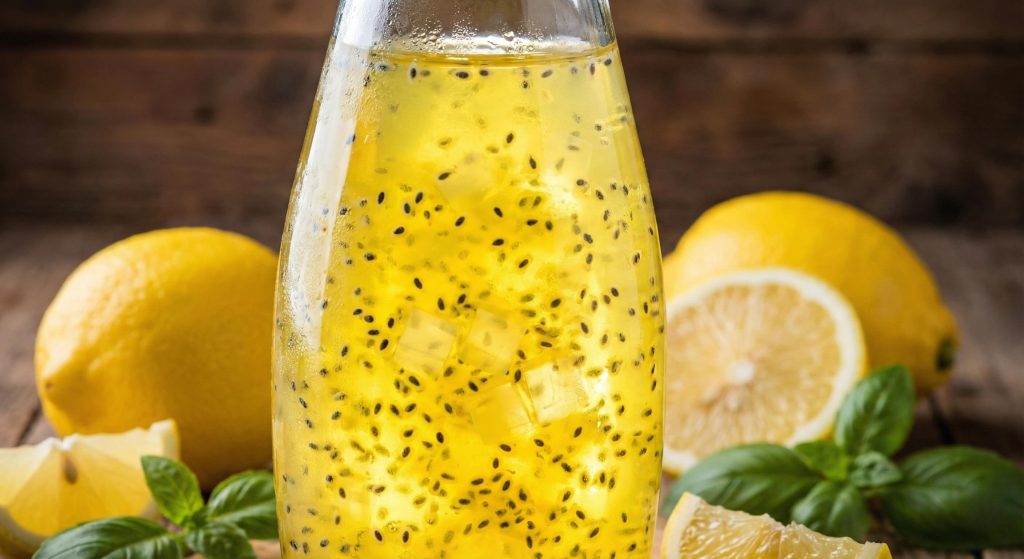
The “Structure Builder”
Low Acyl Gellan Gum is the industry’s choice for structure, clarity, and suspension.
A. Fluid Gel Technology (Suspension Beverages)
This is the single most valuable application of LA Gellan Gum.
- The Concept: By applying shear (mixing) during the gelation cooling process, you break the continuous gel network into microscopic gel particles.
- The Result: A liquid that flows like water (low viscosity) when drunk, but acts like a solid gel at rest.
- Yield Stress: This “Fluid Gel” has a high yield stress, meaning it can suspend heavy particles like Aloe Vera cubes, Basil seeds, or Fruit pulp without them sinking.
- Target Dosage: 0.012% – 0.03% (Extremely low).
B. Water Jellies & Desserts
- Transparency: LA Gellan provides optical clarity superior to Agar.
- Flavor Release: Its brittle structure breaks down instantly in the mouth, offering an immediate and clean flavor burst, unlike starch or gelatin which can mask flavors.
C. Vegan Gummy Candies
- Gelatin Replacement: Replaces gelatin for vegan markets.
- Texture Tuning: Often blended with Modified Starch to reduce brittleness and mimic the “chew” of gelatin.
5. Deep Dive: High Acyl (HA) Gellan Gum Applications
The “Mouthfeel Modifier”
High Acyl Gellan Gum is the secret weapon for creaminess and stabilization.
A. Plant-Based Milk Stabilization
In Almond, Oat, or Soy milk, protein sedimentation is a major issue.
- Mechanism: HA Gellan forms a weak, elastic network that traps insoluble protein and calcium particles.
- Sensory: It adds a “creamy” mouthfeel without the slimy texture of Xanthan Gum or the heaviness of Guar Gum.
- Dosage: 0.02% – 0.05%.
B. Drinkable Jellies
- Texture: Creates a unique “slurpable” gel that breaks down easily when sucked through a straw/pouch.
- Process: Can be pasteurized without losing texture due to its reversible nature.
6. Synergistic Blending: The Art of Formulation
Rarely is Gellan Gum used alone. Understanding synergies can reduce costs and optimize texture.
1. LA Gellan + Konjac Gum
- Effect: Reduces brittleness.
- Result: Makes the gel more elastic and tough (tear-resistant). Ideal for Vegan Meat casings or jelly candies.
2. LA Gellan + Xanthan Gum
- Effect: Syneresis control.
- Result: LA Gellan tends to “weep” water over time. Adding 0.05% Xanthan Gum binds the free water, extending the shelf life of puddings and jellies.
3. HA Gellan + Starch
- Effect: Viscosity boost.
- Result: In dairy desserts, this combination creates a rich, fat-like mouthfeel (fat mimetic) allowing for low-fat product claims.
7. Practical Formulation Recipes (Starting Points)
Disclaimer: These are starting formulations. Adjustment for local water quality and ingredients is required.
Formula A: Aloe Vera Suspension Drink (Fluid Gel)
- Water: 85.0%
- Sugar/Syrup: 10.0%
- Aloe Vera Cubes: 5.0%
- Citric Acid: 0.15% (Add last)
- Sodium Citrate: 0.05%
- HylixChem LA Gellan Gum: 0.025%
- Process:
- Dry blend Gellan with Citrate and some sugar.
- Disperse in water and heat to 90°C.
- Cool to 40°C under constant agitation to form fluid gel.
- Add acid and Aloe cubes. Fill.
Formula B: Vegan Gummy Bear (Firm)
- Water: 30.0%
- Glucose Syrup: 35.0%
- Sucrose: 30.0%
- HylixChem LA Gellan Gum: 1.2%
- Citric Acid solution (50%): 1.5%
- Flavor/Color: As needed.
- Process:
- Boiled sugar/glucose/water.
- Add pre-hydrated Gellan solution.
- Cook to 75 Brix.
- Add acid/flavor and deposit immediately into molds.
Formula C: Oat Milk Stabilizer
- Oat Base: 99.0%
- HylixChem HA Gellan Gum: 0.035%
- Salt: 0.1%
- Process:
- Disperse HA Gellan into oat slurry before homogenization.
- UHT treat (140°C for 4s).
- Cool and fill.
8. Technical Comparison Matrix (Extended)
| Feature | Low Acyl (LA) | High Acyl (HA) | Agar-Agar | Carrageenan (Kappa) |
|---|---|---|---|---|
| Visual | Transparent | Opaque | Cloudy | Transparent/Cloudy |
| Texture | Hard, Brittle | Soft, Elastic | Brittle | Firm, Brittle |
| Melting Point | >120°C | ~75°C | ~85°C | ~60°C |
| Setting Temp | 30-50°C | 70-80°C | 35-40°C | 40-50°C |
| Acid Stability | Good (pH 3.5+) | Good (pH 3.5+) | Poor | Poor (Hydrolyzes) |
| Dosage | Very Low | Very Low | High | Medium |
| Ion Need | High (Ca++) | Low | No | High (K+) |
9. Manufacturing & Quality Control at HylixChem
Understanding how we make it helps you understand what you are buying.
- Fermentation: A pure culture of Sphingomonas elodea is inoculated into a glucose-based medium enriched with nitrogen and phosphate. Fermentation lasts 2-4 days under strict aerobic conditions.
- Pasteurization: The broth is heated to kill viable bacteria (post-fermentation).
- De-acylation (For LA only): Alkali (KOH or NaOH) is added to the broth to strip the acyl groups.
- Precipitation: Alcohol (Isopropanol) is added to precipitate the gum fibers from the broth.
- Drying & Milling: The fibers are dried and milled to specific mesh sizes (usually 80 mesh).
Quality Parameters We Test:
- Gel Strength: Tested using a Texture Analyzer on a standard 0.5% gel puck.
- Transmittance: Tested on a spectrophotometer (critical for LA grade).
- Microbiology: Total Plate Count, Yeast/Mold, Salmonella (Negative).
10. Regulatory Status & Safety
Gellan Gum is globally approved and recognized as safe.
- E-Number: E418 (Approved by EFSA for use in EU).
- US FDA: 21 CFR 172.665 (Direct Food Additive).
- JECFA: ADI “Not Specified” (Highest safety rating).
- Organic Status: Permitted in USDA Organic products (under specific non-synthetic/fermentation clauses).
- Dietary: Kosher Pareve and Halal Certified (No animal origin).
11. Troubleshooting Common Defects
| Issue | Gellan Type | Likely Cause | Solution |
|---|---|---|---|
| Gel is cloudy | LA | Incomplete hydration; High calcium water. | Heat >90°C; Use sequesterant (Sodium Citrate); Switch to DI water. |
| Pre-gelation | LA | Adding ions too early. | Add Calcium/Acid after hydration and heating. |
| Sedimentation | HA/LA | Filling temp too high (viscosity too low). | Cool closer to setting point before filling; Increase dosage. |
| Syneresis | LA | Gel matrix too tight. | Reduce Calcium; Add Xanthan Gum or LBG. |
| Slimy Texture | HA | Dosage too high. | Reduce dosage; Blend with LA type. |
12. Strategic Sourcing: Why HylixChem?
Sourcing Gellan Gum requires a partner who understands Application Specificity.
- Grade Variety: We don’t just sell “Gellan”. We sell “Suspension Grade”, “Jelly Grade”, and “Plant-Milk Grade”.
- Cost Control: As fermentation yields improve, we pass savings to customers. Our bulk pricing is competitive against legacy EU/US suppliers.
- Technical Support: Our lab can run TPA tests on your finished product to match the texture of your target benchmark.
13. Frequently Asked Questions (FAQ)
Q: Can I hydrate Gellan Gum in cold water? A: No. Both HA and LA types require heating to hydrate. LA requires roughly 75°C-90°C (depending on ions present), while HA generally hydrates around 85°C.
Q: Does Gellan Gum interact with proteins? A: Yes. HA Gellan Gum interacts with casein and plant proteins at acidic pH, which is beneficial for stabilization. LA Gellan is generally inert but provides the structural cage.
Q: Is Gellan Gum sensitive to shear? A: The gel is sensitive (shear can break it), but the fluid gel relies on this shear. The polymer chain itself is very robust and does not degrade under standard pumping conditions.
Q: Can I use Gellan Gum in high-sugar confectionery? A: Yes, but hydration must happen before the sugar concentration gets too high. High soluble solids compete for water and can prevent the gum from hydrating. Dissolve gum in water first, then add sugar.
Ready to Engineer the Perfect Texture?
Whether you need the crystal clarity of Low Acyl or the creamy stability of High Acyl, HylixChem delivers consistency you can measure.
- Request a Sample Kit: Click Here to Contact Us
- Download TDS/COA: Visit Product Page